This is a small Danish convention with a few hundred people attending. Only foreign Guest was Norman Spinrad. The con was held in the "Vanloese Kulturhus" (cultural house) in nice large rooms and a terrace. Even the weather cooperated and we could sit outside chatting along between the programmed events. I arrived there after a long (12 hour) drive and a few hours of sleep.
On Saturday I went to the interview with Niels Brunse who has translated a large amount of English language books into Danish, and also written stories of his own. He was, among other subjects, talking about the difficulty of making a good translation, something I can relate to in a limited capacity, having attempted translation in both directions between Danish and English. Some elegant words or phrases in one language translate *very* poorly into the other.
Sunday had a surprise guest speaker, the Danish physicist Holger Bech Nielsen, giving a presentation of his version of the "theory of everything" : "Random Dynamics". He is a *very* lively lecturer, and it is always fun to see him, his enthusiasm for the subject is just radiating from him. This was the first time I saw him "live", the other times were just on television.
Arthur C. Clarke :
For me the best part of the programme on Sunday was the panel discussion about Arthur C. Clarke, the panel consisting of 3 Danish fans and the guest speaker Norman Spinrad. Spinrad had sopme cooperation with Clarke in the 1960's and could tell us that the final scene of the movie "2001 - A Space Odyssey" was in fact not the one we saw in the movie. Clarke had envisioned a scene with very beautiful aliens, but it was not technically possible to do to his satisfaction - meaning the scene had to be rewritten.
Clarke's relatively optimistic view of the future has by some been regarded as naive, but it most probably is an expression of his dream about the future.
Finally there was a discussion of Clarke's unusual combination of hard science fiction and the "mystical" (for lack of a better word), something very prominent in "2001", but it is in much of his other work.
Of course, you cannot mention Arthur C. Clarke without talking about his strong influence on science and technology (as well as science fiction), interesting to see how many of his early thoughts have come true already.
All in all a very nice week end , I will try to make it again next year.
Showing posts with label science. Show all posts
Showing posts with label science. Show all posts
Tuesday, 29 April 2008

Thursday, 10 April 2008
More real life space communications (2)
The Soyuz spacecraft has successfully docked to the ISS today.
Yesterday I listened for radio communications from the Soyuz, and was rewarded with hearing a few exchanges in Russian. They were likely talking to the ground station in Moscow. The frequency for Soyuz is 121.750 MHz, if any of you should have a scanner receiver. The signal was quite strong, even with a wrong sized antenna, so it should not be too difficult to hear.
Good hunting if you try - They will probably be radio-active for a day or two when they leave the ISS and return to Earth.
In the meantime , if you are in Europe, you can listen for the ISS , in the rare cases when they talk back to Moscow, on the frequency 143.625 MHz.
Yesterday I listened for radio communications from the Soyuz, and was rewarded with hearing a few exchanges in Russian. They were likely talking to the ground station in Moscow. The frequency for Soyuz is 121.750 MHz, if any of you should have a scanner receiver. The signal was quite strong, even with a wrong sized antenna, so it should not be too difficult to hear.
Good hunting if you try - They will probably be radio-active for a day or two when they leave the ISS and return to Earth.
In the meantime , if you are in Europe, you can listen for the ISS , in the rare cases when they talk back to Moscow, on the frequency 143.625 MHz.
Tuesday, 1 April 2008
More real life space communications
When STS122 had just been launched, I went out to see if I could spot it and the ISS. The ISS arrived right on time and was *very* bright and easy to see (I missed the Shuttle, though). I had also brought my scanner radio receiver with me, and just before the ISS went into the Earth's shadow , I heard a carrier wave for a few seconds , followed by [chorosho] (Russian for "good") and a few more words in Russian, since they were communicating with a ground station in Russia.
In the first few orbits after launch of the space shuttle(s) and the last few orbits before the re-entry (landing) the shuttle uses the frequency 259.700 MHz (AM) for clear voice communications.
A few weeks later, when the STS-123 was launched, I joined a group listening for the Shuttle "Endeavour". but since the high power (10 Watts) transmitter of the spacecraft was out, they were only transmitting with the low power (0.25 watts) transmitter. with my simple antenna and a long cable in to the receiver the signal was lost here, but a few other people around in Europe did hear them.
Since then I have had a preamplifier mounted at the antenna , so the loss in the cable has been compensated.
In the last few orbits before re-entry I listened for Endavour again - and even with their low power transmitter it was audible here. Signals were weak and noisy, but a few sentences were clearly heard here. Next time I will have to do some recordings.
In the first few orbits after launch of the space shuttle(s) and the last few orbits before the re-entry (landing) the shuttle uses the frequency 259.700 MHz (AM) for clear voice communications.
A few weeks later, when the STS-123 was launched, I joined a group listening for the Shuttle "Endeavour". but since the high power (10 Watts) transmitter of the spacecraft was out, they were only transmitting with the low power (0.25 watts) transmitter. with my simple antenna and a long cable in to the receiver the signal was lost here, but a few other people around in Europe did hear them.
Since then I have had a preamplifier mounted at the antenna , so the loss in the cable has been compensated.
In the last few orbits before re-entry I listened for Endavour again - and even with their low power transmitter it was audible here. Signals were weak and noisy, but a few sentences were clearly heard here. Next time I will have to do some recordings.
Saturday, 29 March 2008
Arthur C. Clarke died at 90
I know this happened last week, but the preparations for going to the Eastercon/Orbital2008 have overshadowed most other things. See also previous post.
I first became aware of Atrhur C. Clarke through the movie/novel "2001 - A Space Oddyssey" which made a considreable impression on my young self.
One of my favorite longer stories by Clarke is "Rendezvous With Rama".
I have on my shelf a brick of a book with about 100 short stories by Clarke , I think I will slowly work my way through those.
At the convention I found a signed copy of "Tales From the White Hart", and despite the (understandably rather high) price I just had to get it. Should read the short stories in that one, too.
I see Arthur C. Clark as one of the giants in science fiction, and a very influential science writer - one of the few science fiction writers with a scientific writer's background.
It was good to see a last minute addition to the Eastercon programme of a panel discussion about Clarke's influence in science as well as science fiction. On top of that, one of the panelists had been the secretary for Arthur C. Clarke for about a year, and he could bring light on theless public sides of the author. Nicely done.
He will be missed in the scifi community.
I first became aware of Atrhur C. Clarke through the movie/novel "2001 - A Space Oddyssey" which made a considreable impression on my young self.
One of my favorite longer stories by Clarke is "Rendezvous With Rama".
I have on my shelf a brick of a book with about 100 short stories by Clarke , I think I will slowly work my way through those.
At the convention I found a signed copy of "Tales From the White Hart", and despite the (understandably rather high) price I just had to get it. Should read the short stories in that one, too.
I see Arthur C. Clark as one of the giants in science fiction, and a very influential science writer - one of the few science fiction writers with a scientific writer's background.
It was good to see a last minute addition to the Eastercon programme of a panel discussion about Clarke's influence in science as well as science fiction. On top of that, one of the panelists had been the secretary for Arthur C. Clarke for about a year, and he could bring light on theless public sides of the author. Nicely done.
He will be missed in the scifi community.
Sunday, 3 February 2008
Real Life Space Communications
As we all know, a lot of science fiction involves space travel. We sometimes tend to forget that real life space travel already takes place, albeit on a somewhat limited scale.
This week end I did a little listening to spacecrafts on the radio. You may not believe it, but space communications is not as difficult as many people would think.
I was finding out when the ISS came over the horizon here and started listening to a relay station for ham (amateur) radio situated on the ISS. If there is not any spacewalks going on, the relay station is active listening on the 435MHz (uplink) band (70cm) and transmitting on the 145MHz (downlink) band (2m).
The downlink on 145.800MHz was clearly audible with a scanner radio and a simple whip antenna, as soon as I went out on the balcony of my apartment. On average the period with audible signals is 10 minutes per pass, shorter when the pass is near the horizon and longer when the station comes over my head.
Many years ago I sometimes set my receiver to 143.625MHz in order to listen for the MIR space station (yes - the Russian one), and have heard that one talking to the Earth station.
On some occasions it is possible to have a contact with one of the astronauts on the ISS, if they have the free time and interest. Almost all the astronauts have the license to transmit from up there.
In fact, the radio hams have several satellite relays orbiting the Earth, giving them the opportunity to try out space communications. Most of those are in a low Earth orbit, and therefore they are only useable for a short time. Some have a very elongated orbit (not really any right now), giving the opportunity for longer communication periods.
Most of us know about TV and communications satellites in the geostationary orbit (the satellite follows the Earth's rotation and seems to be stationary over a certain point on the Earth). The dream of some radio hams is getting their satellite out there, giving 24/7 communications.
Just a dream ... but maybe not any longer. There seems to be negociations going on between the AMSAT (Amateur Satellite) organisation and Inmarsat, about getting a lift with one of their satellites, and even sharing the power from the solar panels. We never know if this will come true, but I sure hope so.
Do not forget that the Space Station is a rather big satellite and is very easy to see when above the horizon. So - even if you cannot receive it on the radio you can go outside and observe a *real life* manned spacecraft. if you want to know when it can be observed at your place , go to Heavens Above and find out. it is a good idea to register, so you can have your location recognised when you log on.
This week end I did a little listening to spacecrafts on the radio. You may not believe it, but space communications is not as difficult as many people would think.
I was finding out when the ISS came over the horizon here and started listening to a relay station for ham (amateur) radio situated on the ISS. If there is not any spacewalks going on, the relay station is active listening on the 435MHz (uplink) band (70cm) and transmitting on the 145MHz (downlink) band (2m).
The downlink on 145.800MHz was clearly audible with a scanner radio and a simple whip antenna, as soon as I went out on the balcony of my apartment. On average the period with audible signals is 10 minutes per pass, shorter when the pass is near the horizon and longer when the station comes over my head.
Many years ago I sometimes set my receiver to 143.625MHz in order to listen for the MIR space station (yes - the Russian one), and have heard that one talking to the Earth station.
On some occasions it is possible to have a contact with one of the astronauts on the ISS, if they have the free time and interest. Almost all the astronauts have the license to transmit from up there.
In fact, the radio hams have several satellite relays orbiting the Earth, giving them the opportunity to try out space communications. Most of those are in a low Earth orbit, and therefore they are only useable for a short time. Some have a very elongated orbit (not really any right now), giving the opportunity for longer communication periods.
Most of us know about TV and communications satellites in the geostationary orbit (the satellite follows the Earth's rotation and seems to be stationary over a certain point on the Earth). The dream of some radio hams is getting their satellite out there, giving 24/7 communications.
Just a dream ... but maybe not any longer. There seems to be negociations going on between the AMSAT (Amateur Satellite) organisation and Inmarsat, about getting a lift with one of their satellites, and even sharing the power from the solar panels. We never know if this will come true, but I sure hope so.
Do not forget that the Space Station is a rather big satellite and is very easy to see when above the horizon. So - even if you cannot receive it on the radio you can go outside and observe a *real life* manned spacecraft. if you want to know when it can be observed at your place , go to Heavens Above and find out. it is a good idea to register, so you can have your location recognised when you log on.
Monday, 29 October 2007
Comet hunt .... Success tonight.
After what feels like an eternity of cloudy weather I got to see comet Holmes.
A bit of clear sky appeared , and the comet was just visible to the unaided eye here (the sky is heavily light polluted where I live).
Without any optical instruments it looks like a star to me - maybe it would be fuzzy in a darker sky.
Using a pair of binoculars at 15x magnification the comet is much like the pictures as seen here , with the exception of the faint green haze outside the brighter disk.
It looked bigger than I expected, and I noticed thet in order to get the most from the view, I had to use "averted vision" that is focusing the view a bit away from the comet. The brighter core is a little elliptic looking and a little offset from the centre of the disk.
If you have a pair of binoculars, you should go out and take a look. The Sky and Telescope link above gives you what you need to find the comet.
This is the third comet I have seen, only Hale-Bopp in April 1997 was bright enough to be clearly seen in the heavily light polluted skies of the western Netherlands, but this unexpected view is much better with a pair of binoculars , or better a telescope using a not too high magnification 20 - 50x should be fine.
Good luck comet hunting.
A bit of clear sky appeared , and the comet was just visible to the unaided eye here (the sky is heavily light polluted where I live).
Without any optical instruments it looks like a star to me - maybe it would be fuzzy in a darker sky.
Using a pair of binoculars at 15x magnification the comet is much like the pictures as seen here , with the exception of the faint green haze outside the brighter disk.
It looked bigger than I expected, and I noticed thet in order to get the most from the view, I had to use "averted vision" that is focusing the view a bit away from the comet. The brighter core is a little elliptic looking and a little offset from the centre of the disk.
If you have a pair of binoculars, you should go out and take a look. The Sky and Telescope link above gives you what you need to find the comet.
This is the third comet I have seen, only Hale-Bopp in April 1997 was bright enough to be clearly seen in the heavily light polluted skies of the western Netherlands, but this unexpected view is much better with a pair of binoculars , or better a telescope using a not too high magnification 20 - 50x should be fine.
Good luck comet hunting.
Thursday, 25 October 2007
Comet bursting into the sky.
Two days ago Comet 17P/Holmes was an insignificant piece of ice barely visible in amateur telescopes under dark skies.
Yesterday all that changed . If you have a clear sky, take a look in the constellation Perseus, there you will find an extra "fuzzy star" - visible to the unaided eye. With a visual magnitude og between 2.5 and 3 it should be about as strong as the stars in the "Big Dipper", "The Plough", "The big Wagon" or whatever you may call the most well known constellation in the Northern sky. The increase in brightness is about a million times in about 24 hours - quite amazing.
Take a look at Spaceweather.com for more information - and a star map to find the comet, and Cometography for a bit of history of this comet.
Stop Press: Latest estimates are now magnitude 2 .... even brighter ... so the outburst is still in progress.
Here's hoping for a little clear sky at my place i The Netherlands ...
Good luck with comet hunting.
Yesterday all that changed . If you have a clear sky, take a look in the constellation Perseus, there you will find an extra "fuzzy star" - visible to the unaided eye. With a visual magnitude og between 2.5 and 3 it should be about as strong as the stars in the "Big Dipper", "The Plough", "The big Wagon" or whatever you may call the most well known constellation in the Northern sky. The increase in brightness is about a million times in about 24 hours - quite amazing.
Take a look at Spaceweather.com for more information - and a star map to find the comet, and Cometography for a bit of history of this comet.
Stop Press: Latest estimates are now magnitude 2 .... even brighter ... so the outburst is still in progress.
Here's hoping for a little clear sky at my place i The Netherlands ...
Good luck with comet hunting.
Monday, 22 October 2007
Radio Astronomy and SETI
On 11 october a new radio telescope started operation. The Allen Telescope Array (ATA) in Hat Creek, CA is planned to be extended to an array of 350 dish antennas with a diameter of 6m (20ft) The inauguration was done with the first 42 of these dishes.
The ATA is built to do simultaneous radio astronmical observations and SETI work.
More detail can be found at the website for the SETI institute ATA ppress release.
I am quite excited, since the data collected from the ATA is *much* more than from traditional single dish telescopes , and more than will come from the VLA (Very Large Array) - and for a cost much loser than for older (traditional) radio telescopes.
For more about SETI (Search for ExtraTerrestrial Intelligence), take a look at at the websites :
SETI Institute
SETI League
SETI@home
The ATA is built to do simultaneous radio astronmical observations and SETI work.
More detail can be found at the website for the SETI institute ATA ppress release.
I am quite excited, since the data collected from the ATA is *much* more than from traditional single dish telescopes , and more than will come from the VLA (Very Large Array) - and for a cost much loser than for older (traditional) radio telescopes.
For more about SETI (Search for ExtraTerrestrial Intelligence), take a look at at the websites :
SETI Institute
SETI League
SETI@home
Monday, 15 October 2007
50 years of the Space Age
October 4th, 1957 saw the first successful launch of a satellite into space.
The (then) USSR lauched "Sputnik 1" becoming the first country entering the Space Age. Its characteristic "beep-beep" sound was heard by radio enthusiasts all over the world on approx. 20 MHz and 40 MHz. MOre information and a recording of the beeps can be found at the Wikipedia page concerning Sputnik 1 . (link at the bottom of the page)
One month later, on November 3rd, a second launch of Sputnik 2 with the first living being put in orbit. The dog Laika, unfortunately, had no way of returning alive to earth.
The first satellite launched by the US was Explorer 1 , on January 31st, 1958.
This marks the beginning of the "Space Race", which continued through the 1960's and 70's.
The Space Age has had a lot of "ups and downs" , and I will come up with some highlights in later posts.
The (then) USSR lauched "Sputnik 1" becoming the first country entering the Space Age. Its characteristic "beep-beep" sound was heard by radio enthusiasts all over the world on approx. 20 MHz and 40 MHz. MOre information and a recording of the beeps can be found at the Wikipedia page concerning Sputnik 1 . (link at the bottom of the page)
One month later, on November 3rd, a second launch of Sputnik 2 with the first living being put in orbit. The dog Laika, unfortunately, had no way of returning alive to earth.
The first satellite launched by the US was Explorer 1 , on January 31st, 1958.
This marks the beginning of the "Space Race", which continued through the 1960's and 70's.
The Space Age has had a lot of "ups and downs" , and I will come up with some highlights in later posts.
Thursday, 27 September 2007
Impressions from Eurocon 2007 (3)
Saturday :
A good lecture on the mysterious "Dark Energy" , which is thought to take up ab0ut 70 % of the Universe . Most of the remaining part of the Universe is "Dark Matter" , so all we can see of the totality is about 5 % of it . A bit scary, isn't it ?
In the presentation we heard that two teams had - at the same time - found some surprising results during surveys of supernovas in the furthest corners of our universe. This particular type of supernova was known (or assumed) to have a rather limited range of luminousity - and a lot of light coming from them - meaning that the distance to them could be estimated with a rather good certainty. Other sources of error (such as dust clouds) could be eliminated, and the result was that the expansion of the universe looks like accelerating in stead of slowing down - as we would expect due to gravity. So what we have is a sort of anti-gravity - but only on very large distances. Later other surveys in different fields gave similar results , so the scientists are rather certain that the effect exists. There is just no clue as to the cause of it. Rather exciting to listen to.
More on the Saturday later ...
Jan from Denmark
A good lecture on the mysterious "Dark Energy" , which is thought to take up ab0ut 70 % of the Universe . Most of the remaining part of the Universe is "Dark Matter" , so all we can see of the totality is about 5 % of it . A bit scary, isn't it ?
In the presentation we heard that two teams had - at the same time - found some surprising results during surveys of supernovas in the furthest corners of our universe. This particular type of supernova was known (or assumed) to have a rather limited range of luminousity - and a lot of light coming from them - meaning that the distance to them could be estimated with a rather good certainty. Other sources of error (such as dust clouds) could be eliminated, and the result was that the expansion of the universe looks like accelerating in stead of slowing down - as we would expect due to gravity. So what we have is a sort of anti-gravity - but only on very large distances. Later other surveys in different fields gave similar results , so the scientists are rather certain that the effect exists. There is just no clue as to the cause of it. Rather exciting to listen to.
More on the Saturday later ...
Jan from Denmark
Wednesday, 26 September 2007
Impressions from Eurocon 2007 (2)
This was only my second Scifi convention, the first one being a Star Trek convention in Fresno,California about 15 years ago.
Thursday night :
Already on Thursday evening at the pre-registration there was convention activity. The organisers were quite happy that I offered to make some photos at the con, so they are receiving a CD with photos for every day of the con.
A nice talk with frequent convention goer - and volunteer - Wilf from the UK was already a good start for me. A quite knowledgeable fellow with a solid scientific angle as well.
Friday :
Panel with Guests of Honour. Anne McCaffrey arrived a little late and, when asked, insisted on going up the stairs to the stage (in spite of the handicap) - hats off. A few words from the guests of honour. Harry Harrison is a veteran guest of con's and has quite a few stories to tell.
Anne McCaffrey, too is very experienced in conventions and could tell of her first con's where she had good advice from (then) experienced writers, and expressed her advice to new writers : in short , if you want to write , make youself sit down and write ... every day.
Scientific lecture on Solar eruptions. This has had my interest for a long time, being a licensed radio amateur. For me the content was not new, but a condensed version of what I already knew. Only difference was - this came from a scientist's point of view.
There were lots of other presentations during the day , but these stand out for me. A lot of time went with meeting other fans and discussing science fiction, science and fantasy .
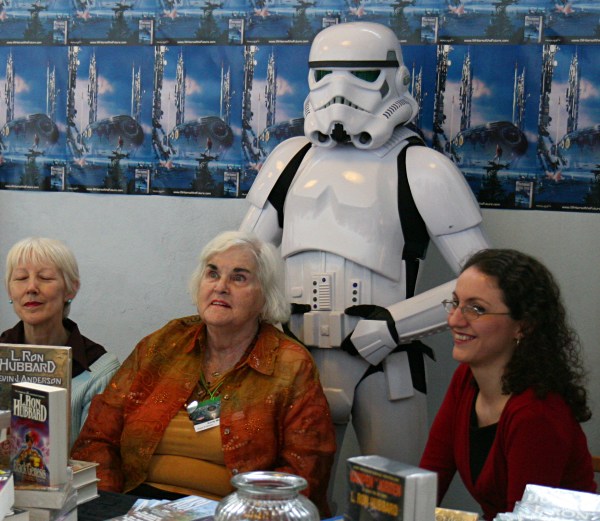
A little fun thing is a photo I made : Anne McCaffrey is also involved in the "Writers of th Future", a quarterly competition, where the winners get their stories published in collections. One moment a Star Wars Stormtrooper in full gear was "standing guard" right behind the famous author, link to the picture .
more to come ...
Jan from Denmark
Thursday night :
Already on Thursday evening at the pre-registration there was convention activity. The organisers were quite happy that I offered to make some photos at the con, so they are receiving a CD with photos for every day of the con.
A nice talk with frequent convention goer - and volunteer - Wilf from the UK was already a good start for me. A quite knowledgeable fellow with a solid scientific angle as well.
Friday :
Panel with Guests of Honour. Anne McCaffrey arrived a little late and, when asked, insisted on going up the stairs to the stage (in spite of the handicap) - hats off. A few words from the guests of honour. Harry Harrison is a veteran guest of con's and has quite a few stories to tell.
Anne McCaffrey, too is very experienced in conventions and could tell of her first con's where she had good advice from (then) experienced writers, and expressed her advice to new writers : in short , if you want to write , make youself sit down and write ... every day.
Scientific lecture on Solar eruptions. This has had my interest for a long time, being a licensed radio amateur. For me the content was not new, but a condensed version of what I already knew. Only difference was - this came from a scientist's point of view.
There were lots of other presentations during the day , but these stand out for me. A lot of time went with meeting other fans and discussing science fiction, science and fantasy .
A little fun thing is a photo I made : Anne McCaffrey is also involved in the "Writers of th Future", a quarterly competition, where the winners get their stories published in collections. One moment a Star Wars Stormtrooper in full gear was "standing guard" right behind the famous author, link to the picture .
more to come ...
Jan from Denmark
Thursday, 30 August 2007
Eurocon 2007
The European Convention on Science Fiction and Fantasy takes place in Copenhagen on 21 - 23 September.
For me the most interesting guest of Honour is Anne McCaffrey. The "Dragonriders of Pern" series is one of my favorite SciFi book series, well written and with an interesting plot.
The first book of the series ,"Dragonflight" was published in 1968 , and since then a steady flow of sequels (and prequels) have come out.
You can find out more at their website Eurocon 2007
If I can find the time (and an Internet connection) I might make a few posts during the days of the Eurocon
For me the most interesting guest of Honour is Anne McCaffrey. The "Dragonriders of Pern" series is one of my favorite SciFi book series, well written and with an interesting plot.
The first book of the series ,"Dragonflight" was published in 1968 , and since then a steady flow of sequels (and prequels) have come out.
You can find out more at their website Eurocon 2007
If I can find the time (and an Internet connection) I might make a few posts during the days of the Eurocon
Thursday, 5 July 2007
Pulsar Measurements - Radio Astronomy Podcast
Just heard this on the podcast "Mountain Radio Astronomy". Their podcast of 8 October 2005 was an interview with pulsar hunter Scott Ransom at the National Radio Astronomy Observatory in Charlottesville. Scott had - at the time of the interview - found about 30 millisecond pulsars in a globular star cluster called Terzan 5.
A pulsar is believed to be a quickly rotating neutron star, a supernova remnant, most of them rotating in less than a second. The pulsar has a rather small and directional radiating area that can only be registered when it is facing us.
A second type of even faster rotating pulsars - known as millisecond pulsars - rotating more than a 100 tomes per second, are found in globular star clusters.
The rotation period of the millisecond pulsars is extremely precise, approaching that of an atomic clock , and this means thatsome interesting measurements of pulsar orbits can be made.
About 20 minutes into the interview he talked about a measurement of a pulsar orbit with an accuracy that really surprised me.
The example here is the Hulse-Taylor star system two pulsars orbiting each other in an orbit smaller than the Sun.This can demonstrate Einstein's general theory of relativity, the interaction between spacetime and gravitation and an indication of gravity waves.
One other of the pulsars, Terzan N is orbiting a massive companion in an almost exact circular orbit about the size of the Sun.there is a little eccentricity, that is difference in the long axis and the short axis of the orbit, is measured as 48 cm +/- 6 cm. Less than half a meter ! Measured at a distance of 20 000 light years. Mind blowing ...
Science stranger than fiction ...
Link to Mountain Radio Astronomy
Link to The podcast MP3 file
A pulsar is believed to be a quickly rotating neutron star, a supernova remnant, most of them rotating in less than a second. The pulsar has a rather small and directional radiating area that can only be registered when it is facing us.
A second type of even faster rotating pulsars - known as millisecond pulsars - rotating more than a 100 tomes per second, are found in globular star clusters.
The rotation period of the millisecond pulsars is extremely precise, approaching that of an atomic clock , and this means thatsome interesting measurements of pulsar orbits can be made.
About 20 minutes into the interview he talked about a measurement of a pulsar orbit with an accuracy that really surprised me.
The example here is the Hulse-Taylor star system two pulsars orbiting each other in an orbit smaller than the Sun.This can demonstrate Einstein's general theory of relativity, the interaction between spacetime and gravitation and an indication of gravity waves.
One other of the pulsars, Terzan N is orbiting a massive companion in an almost exact circular orbit about the size of the Sun.there is a little eccentricity, that is difference in the long axis and the short axis of the orbit, is measured as 48 cm +/- 6 cm. Less than half a meter ! Measured at a distance of 20 000 light years. Mind blowing ...
Science stranger than fiction ...
Link to Mountain Radio Astronomy
Link to The podcast MP3 file
Subscribe to:
Posts (Atom)